A wedding invitation is the first thing guests hold before they ever step through your door. For an Arabic wedding, that piece of paper — or screen — carries centuries of expectation. Get it right and it sets a tone of warmth and respect. Get it wrong and relatives will notice before the ink dries.
What an Arabic Wedding Invitation Traditionally Carries
The classic arabic wedding invitation follows a structure that most Arab families would recognise instantly. It opens with the Basmala — "Bismillah al-Rahman al-Rahim" — or a Quranic verse such as Ar-Rum 30:21, the one about finding tranquility in a spouse. This is not decorative filler. Skipping it in a religious household is the equivalent of forgetting the couple's names.
Below that comes the hosting line, naming the families extending the invitation — typically the bride's family first in many Levantine traditions, though this varies by region and family preference. Then the couple's names, the date in both Hijri and Gregorian calendars where relevant, the venue, and finally the time. Evening events often list a reception start and a ceremony or dinner hour separately.
Dress code and RSVP details sit at the bottom, often in smaller type. Some families add a line asking guests to silence phones during the ceremony — a practical addition that reads as considerate rather than controlling.
Calligraphy or Modern Type — Choosing Your Register
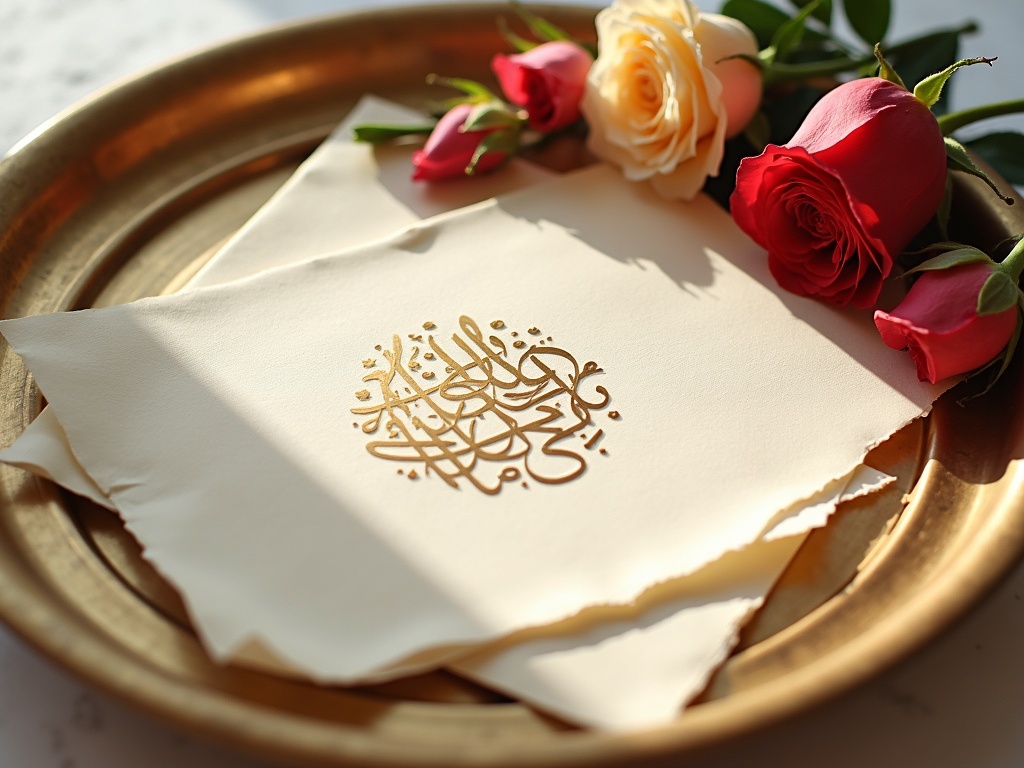
Traditional Arabic calligraphy in styles like Naskh, Thuluth, or Diwani signals formality and heritage. A Thuluth headline above the couple's names looks genuinely beautiful and carries the weight of centuries of Islamic art. If your family is conservative or the wedding is a large formal affair, leaning into calligraphic type is rarely a mistake.
Modern Arabic typefaces — think Tajawal, Lateef, or Cairo — read cleanly on screens and work well when the wedding aesthetic is more contemporary. A Lebanese wedding invitation for a Beirut garden reception might pair a clean Arabic sans-serif with a European typeface like Cormorant Garamond and look entirely coherent. The mistake is mixing registers: ornate Thuluth paired with a casual Latin font creates visual dissonance that guests feel even if they can't name it.
Whatever you choose, test it at the size guests will actually see it. Calligraphic scripts with fine hairlines can collapse into illegibility at 14px on a phone screen.
RTL Design Pitfalls Worth Knowing
Right-to-left text sounds straightforward until you're staring at a layout where the Arabic flows beautifully but the date reads "2025 ,يناير 18" with the numerals stranded on the wrong side. Arabic text runs right to left; numerals and Latin text within that flow need careful handling.
The most common problems:
- Punctuation appearing on the wrong side of a sentence
- Bullet points or list markers sitting to the right of text instead of the left
- Mixed-direction phone numbers breaking mid-string
- Venue names in Latin script creating awkward line breaks inside Arabic paragraphs
- PDF exports from design tools that reorder bidirectional text incorrectly
If you're building a digital invitation, use a platform that has genuine RTL support baked in — not one that just flips text alignment. The difference shows. Venito's Arabic templates are built with proper bidirectional text rendering, so the layout holds whether guests open it in Riyadh or Rotterdam.
Family Names, Lineages, and Introducing the Hosts
In many Arab traditions, the hosting line is not just "The Al-Rashidi Family." It names individuals: the father, sometimes the grandfather, occasionally both sets of parents listed in full. A khaleeji wedding invitation might read: "Sheikh Mohammed bin Khalid Al-Mansoori and his wife Maryam bint Saeed Al-Zaabi request the honour of your presence at the marriage of their daughter..." That level of specificity is not ostentation — it's respect for lineage.
For families navigating modern naming conventions, particularly those with members who use Western name order professionally, decide early which convention the invitation will follow and apply it consistently. Mixing "Dr. Sarah Al-Hassan" with "Khalid bin Yusuf" on the same line creates a small but noticeable inconsistency.
When both families are co-hosting, the order in which they appear matters. Discuss it with both sides before the design is finalised. It is a much easier conversation to have before the proofs are sent than after.
Dual-Language Layouts for International Guests
If your guest list spans Amman, London, and Toronto, a bilingual invitation is not a compromise — it's a courtesy. The question is how to structure it without the design looking like two separate invitations stapled together.
The cleanest approach is a mirrored layout: Arabic on the right panel, English on the left, with shared design elements — a floral border, a geometric motif, the couple's monogram — anchoring both sides visually. Avoid simply translating line-for-line and centring everything; that approach tends to produce an awkward middle column of text that belongs to neither language.
For digital formats, a language toggle works well if it's implemented properly. Guests tap once and see the full invitation in their preferred language, with the layout recomposed for that direction — not just the words swapped into a design built for the other script.
Sending Digitally Without Losing Dignity
There is still a generation of relatives for whom a digital invitation signals that the couple couldn't be bothered. That perception is changing — particularly post-2020 — but it hasn't vanished. The way to counter it is not to apologise for going digital but to make the digital experience feel considered.
That means a custom domain or clean short link rather than a string of random characters. It means the invitation opens to a full-screen design, not a PDF thumbnail the guest has to pinch and zoom. It means RSVP confirmation arrives in Arabic if the guest received an Arabic invitation. Small things, but they accumulate into an impression.
Send a physical card to elderly relatives and close family if the budget allows — even a simple printed card with the digital link as a supplement. For everyone else, a well-built digital arabic wedding card design sent via WhatsApp or email lands just as gracefully as an envelope, provided the craft is there. The medium is not the message. The care is.